11. 实现递归警告!除非你已经能够熟练地实现 recursive 如何 计算出来,只会妨碍理解。
理解递归是如何实现的确实有充分的理由,但帮助你编写递归函数并不在其中。
也许最常见的、使用 stacks 运行时环境 入栈 <push> 来实现的。
这些信息称为 活动记录 出栈
// Recursively compute and return n!
static long rfact ( int n ) {
// fact(20) is the largest value that fits in a long
if (( n < 0 ) || ( n > 20 )) { return - 1 ; }
if ( n <= 1 ) { return 1 ; } // Base case: return base solution
return n * rfact ( n - 1 ); // Recursive call for n > 1
}
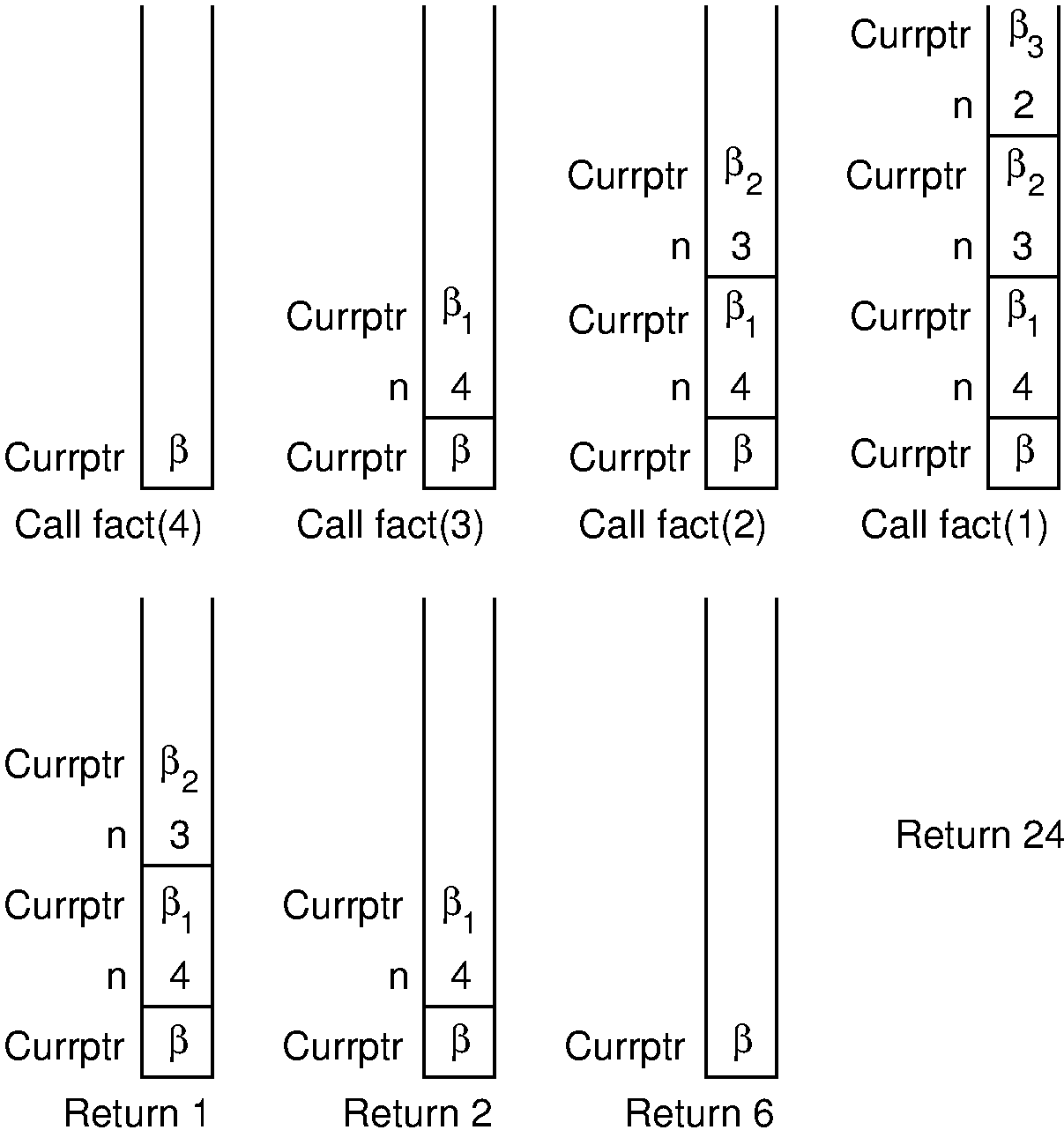
下面是内部处理过程如何工作的图示。
\(\beta\) 值表示当前函数调用完成后要返回的程序指令地址。
每次对 fact n fact
考虑用值 4 调用 fact \(\beta\) 表示发出 fact \(\beta\) ,值 4 被传递给 fact fact \(\beta_1\) 。
地址 \(\beta_1\) 连同 \(n\) 的当前值(即 4)一起保存在栈上。
函数 fact
以类似的方式,又用输入参数 2 进行了一次递归调用,这要求把发出调用的地址(记为 \(\beta_2\) )和 \(n\) 的当前值(即 3)存储在栈上。
最后用输入参数 1 进行一次递归调用,这要求栈存储调用地址(记为 \(\beta_3\) )和当前值(即 2)。
此时,我们已经到达 fact fact \(n\) 值以及函数调用的返回地址。
fact \(n\) 值相乘,然后返回结果。
因为每次子例程调用都必须创建一个活动记录并将其放入栈中,所以进行子例程调用是相对昂贵的操作。
虽然递归常常被用来让实现变得简单清晰,但有时你可能想消除递归函数调用带来的开销。
在某些情况下,例如上面的阶乘函数,递归可以很容易地用迭代来替代。
Example 7.11.1
作为用栈替代递归的一个简单例子,考虑下面这个非递归版本的阶乘函数。
// Return n!
static long sfact ( int n ) {
// fact(20) is the largest value that fits in a long
if (( n < 0 ) || ( n > 20 )) { return - 1 ; }
// Make a stack just big enough
Stack S = new AStack ( n );
while ( n > 1 ) { S . push ( n -- ); }
long result = 1 ;
while ( S . length () > 0 ) {
result = result * ( Integer ) S . pop ();
}
return result ;
}
这里,我们只是把越来越小的 \(n\) 值依次入栈,直到到达基本情况,然后反复弹出所存储的值并把它们乘入结果中。
阶乘函数的迭代形式比示例中所示的版本既更简单也更快。
但并非总能以迭代替代递归。
在实现需要多次分支的算法(例如汉诺塔算法)时,或者在 traversing a binary tree Mergesort Quicksort
Example 7.11.2
下面是汉诺塔的一个递归实现。
// Compute the moves to solve a Tower of Hanoi puzzle.
// Function move does (or prints) the actual move of a disk
// from one pole to another.
// n: The number of disks
// start: The start pole
// goal: The goal pole
// temp: The other pole
static void TOHr ( int n , Pole start , Pole goal , Pole temp ) {
if ( n == 0 ) { return ; } // Base case
TOHr ( n - 1 , start , temp , goal ); // Recursive call: n-1 rings
move ( start , goal ); // Move bottom disk to goal
TOHr ( n - 1 , temp , goal , start ); // Recursive call: n-1 rings
}
// Compute the moves to solve a Tower of Hanoi puzzle.
// Function move does (or prints) the actual move of a disk
// from one pole to another.
// n: The number of disks
// start: The start pole
// goal: The goal pole
// temp: The other pole
static void TOH ( int n , Pole start , Pole goal , Pole temp ) {
if ( n == 0 ) return ; // Base case
TOH ( n -1 , start , temp , goal ); // Recursive call: n-1 rings
move ( start , goal ); // Move bottom disk to goal
TOH ( n -1 , temp , goal , start ); // Recursive call: n-1 rings
}
TOH \(n-1\) 个圆环从最底下的圆环上移开,另一次把这 \(n-1\) 个圆环移回目标柱子。
我们可以用一个栈来存储 TOH
static class TOHobj {
int op ;
int num ;
Pole start , goal , temp ;
// Recursive call operation
TOHobj ( int o , int n , Pole s , Pole g , Pole t )
{ op = o ; num = n ; start = s ; goal = g ; temp = t ; }
// MOVE operation
TOHobj ( int o , Pole s , Pole g )
{ op = o ; start = s ; goal = g ; }
}
static void TOHs ( int n , Pole start , Pole goal , Pole temp ) {
// Make a stack just big enough
Stack S = new AStack ( 2 * n + 1 );
S . push ( new TOHobj ( TOH , n , start , goal , temp ));
while ( S . length () > 0 ) {
TOHobj it = ( TOHobj ) S . pop (); // Get next task
if ( it . op == MOVE ) { // Do a move
move ( it . start , it . goal );
}
else if ( it . num > 0 ) { // Imitate TOH recursive solution (in reverse)
S . push ( new TOHobj ( TOH , it . num - 1 , it . temp , it . goal , it . start ));
S . push ( new TOHobj ( MOVE , it . start , it . goal )); // A move to do
S . push ( new TOHobj ( TOH , it . num - 1 , it . start , it . temp , it . goal ));
}
}
}
class TOHobj {
int op ;
int num ;
Pole start , goal , temp ;
// Recursive call operation
TOHobj ( int o , int n , Pole s , Pole g , Pole t )
{ op = o ; num = n ; start = s ; goal = g ; temp = t ; }
// MOVE operation
TOHobj ( int o , Pole s , Pole g )
{ op = o ; start = s ; goal = g ; }
}
void TOHs ( int n , Pole start , Pole goal , Pole temp ) {
// Make a stack just big enough
Stack S = new AStack ( 2 * n + 1 );
S . push ( new TOHobj ( TOH , n , start , goal , temp ));
while ( S . length () > 0 ) {
TOHobj it = ( TOHobj ) S . pop (); // Get next task
if ( it . op == MOVE ) // Do a move
move ( it . start , it . goal );
else if ( it . num > 0 ) { // Imitate TOH recursive solution (in reverse)
S . push ( new TOHobj ( TOH , it . num -1 , it . temp , it . goal , it . start ));
S . push ( new TOHobj ( MOVE , it . start , it . goal )); // A move to do
S . push ( new TOHobj ( TOH , it . num -1 , it . start , it . temp , it . goal ));
}
}
}
我们首先枚举可能的操作 MOVE 和 TOH,分别表示对 move TOH TOHobj
这里使用基于数组的栈,因为我们知道栈恰好需要存储 \(2n+1\) 个元素。
新版本的 TOH \(n\) 个圆环的初始问题的描述放入栈中。
函数的其余部分只是一个 while TOH \(n>0\) 时),我们把递归版本所执行的三种操作的表示存储在栈上。
然而,这些操作必须以相反的顺序放入栈中,这样才能以正确的顺序弹出。
当描述一个子问题所需的信息量很小时,递归算法很适合用栈来高效实现。
例如,Quicksort