
8.1. Properties of Context-Free Languages
8.1.1. Properties of Context-Free Languages
Note
We will not cover Theorem 8.2
Which of the following languages are CFL?
\(L = \{a^nb^nc^j \mid 0 < n\le j\}\)
Note
NOT CFL
\(L = \{a^nb^ja^nb^j \mid n>0, j>0\}\)
Note
NOT CFL
\(L = \{a^nb^ja^kb^p \mid n+j \le k+p, n>0, j>0, k>0, p>0 \}\)
Note
CFL
\(L = \{a^nb^ja^jb^n \mid n>0, j>0\}\)
Note
CFL
Pumping Lemma for Regular Languages
Let \(L\) be a regular language, then there is a constant \(m\) such that \(w\in L\), \(|w|\ge m\), \(w = xyz\) such that
\(|xy| \le m\)
\(|y| \ge 1\)
for all \(i\ge 0, xy^iz \in L\)
We were able to show that \(a^nb^n\) is not a regular language.
Pumping Lemma for CFL’s
Let \(L\) be any infinite CFL. Then there is a constant \(m\) depending only on \(L\), such that for every string \(w\) in \(L\), with \(|w| \ge m\), we may partition \(w = uvxyz\) such that:
\(|vxy| \le m\), (limit on size of substring)\(|vy| \ge 1\), (\(v\) and \(y\) not both empty)For all \(i \ge 0, uv^ixy^iz \in L\)
Proof: (sketch)
There is a CFG \(G\) such that \(L = L(G)\).
Consider the parse tree of a long string in \(L\).
For any long string, some nonterminal \(N\) must appear twice in the path.
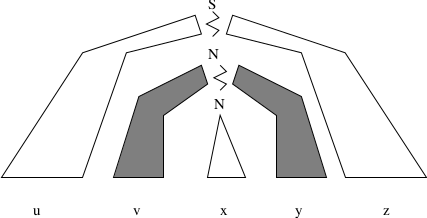
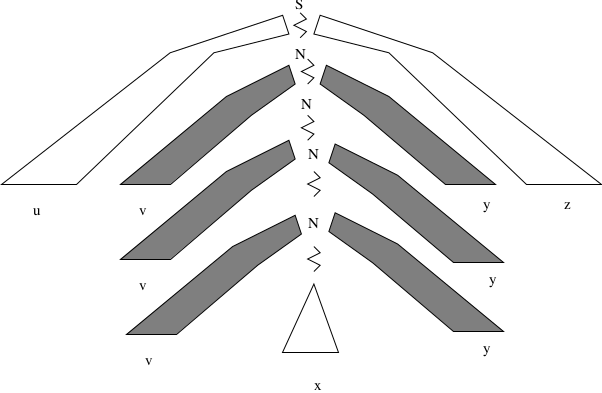
QED
Proof: (by contradiction)
Assume \(L\) is a CFL and apply the pumping lemma.Let \(m\) be the constant in the pumping lemma and consider \(w = a^mb^mc^m\). Note \(|w|\ge m\).Show there is no division of \(w\) into \(uvxyz\) such that \(|vy|\ge 1\), \(|vxy|\le m\), and \(uv^ixy^iz \in L\) for \(i = 0, 1, 2, \ldots\).Case 1: Neither \(v\) nor \(y\) can contain 2 or more distinct symbols. If \(v\) contains \(a\) ‘s and \(b\) ‘s, then \(uv^2xy^2z \notin L\) since there will be \(b\) ‘s before \(a\) ‘s.Thus, \(v\) and \(y\) can be only \(a\) ‘s, \(b\) ‘s, or \(c\) ‘s (not mixed).Case 2: \(v = a^{t_1}\), then \(y = a^{t_2}\) or \(b^{t_3} (|vxy| \le m)\)If \(y = a^{t_2}\), then \(uv^2xy^2z = a^{m+t_1+t_2}b^mc^m \notin L\) since \(t_1 + t_2 > 0, n(a) > n(b)\) (number of \(a\) ‘s is greater than number of \(b\) ‘s)If \(y = b^{t_3}\), then \(uv^2xy^2z = a^{m+t_1}b^{m+t_3}c^m \notin L\) since \(t_1 + t_3 > 0\), either \(n(a) > n(c)\) or \(n(b) > n(c)\).Case 3: \(v = b^{t_1}\), then \(y = b^{t_2}\) or \(c^{t_3}\).If \(y = b^{t_2}\), then \(uv^2xy^2z = a^mb^{m+t_1+t_2}c^m \notin L\) since \(t_1 + t_2 > 0, n(b) > n(a)\).If \(y = c^{t_3}\), then \(uv^2xy^2z = a^mb^{m+t_1}c^{m+t_3} \notin L\) since \(t_1 + t_3 > 0\), either \(n(b) > n(a)\) or \(n(c) > n(a)\).Case 4: \(v = c^{t_1}\), then \(y = c^{t_2}\).Then, \(uv^2xy^2z = a^mb^mc^{m+t_1+t_2} \notin L\) since \(t_1 + t_2 > 0, n(c) > n(a)\).Thus, there is no breakdown of \(w\) into \(uvxyz\) such that \(|vy| \ge 1\), \(|vxy| \le m\) and for all \(i\ge 0\), \(uv^ixy^iz\) is in \(L\).This is a contradiction, thus, \(L\) is not a CFL. Q.E.D.
8.1.1.1. (Chap 8.2) Closure Properties of CFLs
Example: \(L=\{a^nb^n | n>0\}\), \(L\circ L = \{a^nb^na^mb^m | n>0, m>0 \}\)
Note
Example for theorem below:
Questions about CFL:
1. Decide if CFL is empty?Know how to get rid of useless variables and productions, if there is anything left, then CFL is not empty.2. Decide if CFL is infinite?Get rid of useless variables and productions, \(\lambda\)-rules, and unit productions. Then if there is a variable that repeats \(A \stackrel{*}{\Rightarrow} xAy\), then \(L\) is infinite.Note
What type of language is a grammar that has this property? How do we recognize it automatically?
The following “adversary game” is similar to the one used to help prove that a grammar is not regular.