Want to show that each NPDA represents a CFL, so we
will take a NPDA \(M\) and convert it to a CFG.
It will be an easier construction if we take the NPDA and put all the
transitions in a simpler form.
Proof:
Given NPDA \(M\), first, construct an equivalent NPDA
\(M'\) that will be easier to work with.
Construct \(M'\) such that
1. \(M'\) accepts if stack is empty
2. Each move increases or decreases stack content by a single
symbol.
(Can only push 2 variables or no variables with each transition.)
\(M' = (Q, \Sigma, \Gamma, \delta, q_0, z, F)\)
Construct \(G = (V,\Sigma, S, P)\) where
\(V = \{(q_icq_j)\ |\ q_i, q_j \in Q, c \in \Gamma \}\)
(Some of these variables will be useless.)
\((q_icq_j)\) represents “starting at state \(q_i\) the
stack contents are \(cw, w \in \Gamma^*\),
some path is followed to state \(q_j\) and the
contents of the stack are now \(w\)”.
Goal: \((q_0zq_f)\) which will be the start symbol in
the grammar.
Meaning: We start in state \(q_0\) with \(z\) on the
stack and process the input tape.
Eventually we will reach the final state \(q_f\) and the
stack will be empty. (Along the way we may push symbols on the
stack, but these symbols will be popped from the stack).
(NOTE: Machine accepts by empty stack, but it is such that there
is only 1 final state in which the machine accepts by final state.)

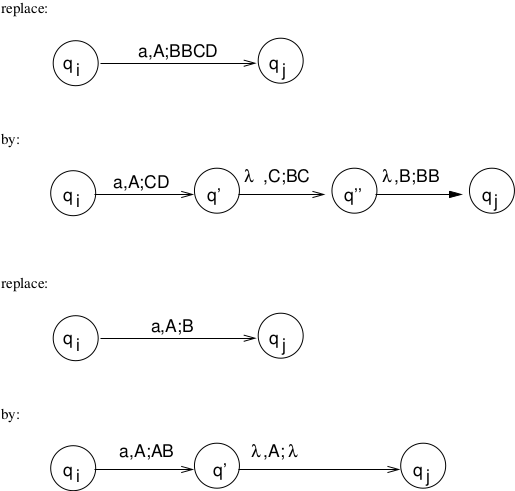


 by\[(q_iAq_j) \rightarrow a\]where the stack changes are:\[\begin{split}\begin{array}{lcclc} & q_i & \ \ (\mbox{some path}\ \rightarrow) \ \ & &q_j \\ \\ \mbox{stack:} & A && \mbox{stack:} & \\ & X_1 & && X_1 \\ & X_2 &&& X_2 \\ & \underline{X_n} &&& \underline{X_n} \\ \end{array}\end{split}\]2) Replace
 by\[(q_iAq_k) \rightarrow a(q_jBq_l)(q_lCq_k)\ \mbox{for all}\ q_l, q_k \in Q\]\[\begin{split}\begin{array}{ccccccc} q_i & \ \ (\mbox{path}\ \rightarrow) \ \ & q_j &\ \ (\mbox{path}\ \rightarrow) \ \ & q_l &\ \ (\mbox{path}\ \rightarrow) \ \ & q_k \\ \\ &&B&& \\ A && C &&C \\ X_1 & & X_1 & & X_1 & & X_1 \\ X_2 && X_2 && X_2 && X_2 \\ \underline{X_n} &&\underline{X_n} &&\underline{X_n} &&\underline{X_n}\\ \end{array}\end{split}\]This will create some useless variables, but that’s ok.Must show that the constructed grammar \(G\) is such that \(L(G) = L(M')\). That is, \(w \in L(G) \mbox{iff}\ w \in L(M)\). (see book) QED.