
7.1. Object-Oriented Inheritance, Overriding, and Interfaces
In earlier chapters, you learned how to create subclasses and define custom
methods. In this chapter, you will explore the full power of object-oriented
inheritance: navigating class hierarchies rooted at Java’s universal base class
Object, specializing behaviors through method overriding (@Override),
and leveraging runtime polymorphism and dynamic method dispatch to write
flexible, extensible software systems.
7.1.1. Class Hierarchy and Inheritance
How are classes related to each other? In Java, and in any other
object-oriented language, classes are organized in a class hierarchy.
A class hierarchy is like an upside-down tree. At the very top of the
hierarchy is the most general class. In Java, the most general class is
the Object class. The classes below Object in the hierarchy are
known as its subclasses. Since
all of the objects we use in our programs belong to some class or other,
this is like saying that all objects are Objects.
The figure below illustrates the concept of a class hierarchy using the
classes that we have described in this section. Notice that the Object
class occurs at the top of the hierarchy. It is the most general class. It
has features that are common to all Java objects. As you move down the
hierarchy, the classes become more and more specialized. A Rectangle is
an Object but it contains attributes–length and width–-that are
common to all rectangles but not to other objects in the hierarchy. For
example, an ATM object does not necessarily have a length and a width.
Notice that we have added a square class to the hierarchy. A square
is a special type of Rectangle, namely one who’s length equals its width.
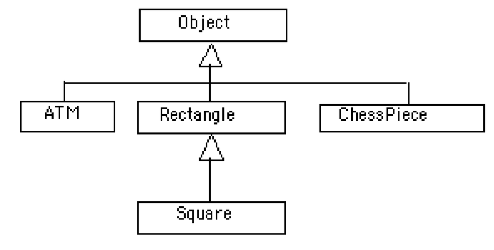
To introduce some important terminology associated with this kind of
hierarchy, we say that the Rectangle class is a subclass of
the Object class. The square class is a subclass of both square
and Object. Classes that occur above a given class in the hierarchy are
said to be its superclasses. Thus Rectangle class is superclass of
the square class. The Object class is also a superclass of square.
In general, we say that a subclass extends a superclass, meaning that it
adds additional elements (attributes and/or methods) to those contained in
its superclasses. We saw this in the case of the square class. It adds
the feature that its length and width are always equal.
Another important concept associated with a class hierarchy is the notion of class inheritance, whereby a subclass inherits all the attributes and methods from its superclass. To take an example from the natural world, think of the sort of inheritance that occurs between a horse and a mammal. A horse is a mammal. So horses inherit the characteristic of being warm blooded by virtue of also being mammals. (This is different from the kind of individual inheritance whereby you inherit your mother’s blue eyes and your father’s black hair).
To illustrate how inheritance works in programming, consider a chess program.
There are several different types of ChessPiece objects. There
are Pawns, and Knights, and Queens, and Kings.
The figure below illustrates the chess piece hierarchy.
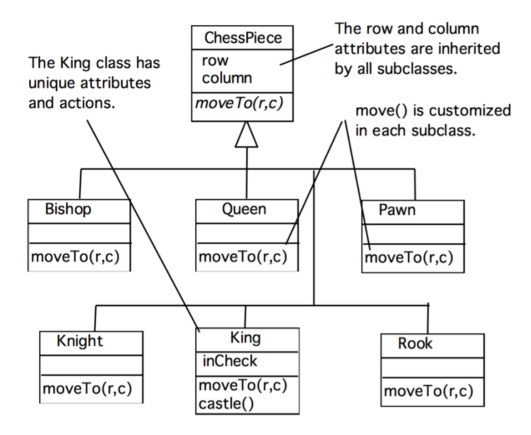
A pair of attributes that all chess pieces have in common is their row
and column position on the chess board. Because all chess pieces have
these attributes in common, they are located at the top of the ChessPiece
hierarchy and inherited by all ChessPiece subclasses. Of course,
the row and column attributes have different values in
each ChessPiece object.
One of the actions that all chess pieces have in common is that they
can moveTo() a given square on the chess board. But different types of
chess pieces have different ways of moving. For example,
a Bishop can only move along diagonals on the chess board, whereas
a Rook can only move along a row or column on the chess board.
So, clearly, we can’t describe a moveTo() method that will work for
all ChessPieces. This is why we put the moveTo() method in all of
the ChessPiece subclasses. The ChessPiece class also has
a moveTo() method, but note that its name is italicized in the diagram.
This indicates that it cannot be completely defined at that level.
Finally, note that in chess, the king has certain special attributes and
actions. Thus only the king can be put in check. This means that the king
is under attack and in danger of being captured, thereby ending the game.
Similarly, only the king has the ability to castle. This is special move
that a king can make together with one of its rooks under certain conditions.
Thus, the reason we show the inCheck attribute and castle() action
in the King class is because these are characteristics that particular
to King objects.
In this way, a class hierarchy represents a specialization of classes as you
move from top to bottom. The most general class, ChessPiece, is at the top
of the hierarchy. Its attributes and methods are passed on to (inherited by)
its subclasses. However, in addition to the attributes and methods they
inherit from their superclasses, the subclasses define their own special
attributes and methods. Each of the subclasses, Pawn, Bishop
and so on, represents some kind of specialization of the superclass. In this
example, each of the subclasses have their own distinctive ways of moving.
And the King subclass has unique attributes and actions (inCheck
and castle()).
7.1.2. What is Polymorphism?
All jeroos understand the same set of messages–that is, they respond to the same method invocations. But now that you’ve seen how define custom methods, it is also possible for a subclass to redefine a method to do something more or to alter its behavior. It turns out that different jeroos might respond to the same method call in different ways, depending on which subclass they belong to. We use the term receiver to refer to the object on which a method is called. Each time you call a method, the receiver determines how to respond, so the exact behavior depends on how the method is defined in the specific subclass used to create the receiver.
Polymorphism means that different receivers can respond to the same method
call in different ways. Polymorphism is not just a theoretical concept; it’s a
powerful tool for writing clean, flexible, and maintainable code. In essence,
it allows a single interface to represent multiple underlying forms. For
example, if you have a Vehicle superclass and subclasses like Car, Bicycle,
and Truck, a function that takes a Vehicle as an argument can work with any
of these subclasses, without needing to know their specific type at compile
time. This is incredibly useful for building extensible systems. You can add
a new subclass, like Motorcycle, and your existing code that works with Vehicle
objects will still function correctly without any changes. This concept of single
interface, multiple implementations is the core benefit of polymorphism in
practice.